Download a PDF of this Press Release
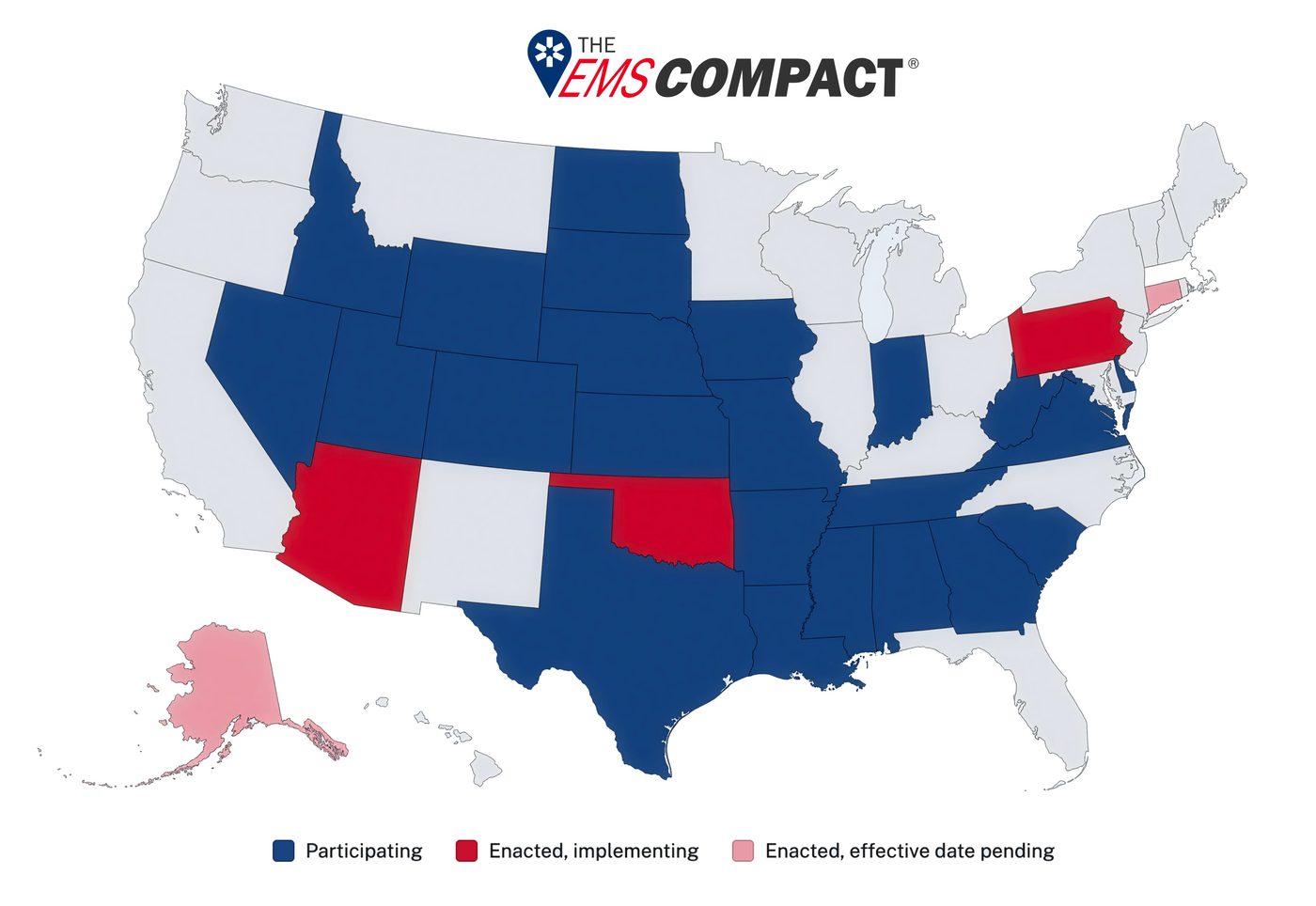
WASHINGTON (18 MAY 2026)— In recognition of EMS Week 2026 (May 17 through 23, “Improving Outcomes, Together”), the Interstate Commission for EMS Personnel Practice, the governmental body that administers the United States EMS Compact across twenty-five member states and more than 450,000 licensed EMS clinicians, today announced the first national, personalized recognition campaign in its history, delivering individual Certificates of Recognition to more than 400,000 EMS clinicians across the country.
The campaign coincides with a new analysis from the National EMS Coordinated Database confirming that residents of all fifty states, the District of Columbia, Puerto Rico, and U.S. military overseas addresses now hold an active multistate Privilege to Practice, obtained through licensure issued by a Compact member state.
“EMS Week is about recognizing the people behind the profession. This year, for the first time in our history, the Commission can recognize them individually, by name, by license level, and by state. That is possible because of the National EMS Coordinated Database, the first identity-resolved EMS workforce dataset in the United States. The same dataset that allows us to thank every clinician personally also shows us something we have never been able to confirm before. EMS clinicians representing every state are now participating in the United States EMS Compact framework. The Compact is no longer a regional framework. Its operational reach is national,” said Donnie Woodyard, Jr., Executive Director of the Interstate Commission for EMS Personnel Practice.
“The Compact was established by state legislatures, and it is governed by commissioners appointed by each member state. What this campaign demonstrates is that the framework those states built together is now serving clinicians from every corner of the country. On behalf of the Commissioners, I want to thank every EMS clinician who carries a Privilege to Practice. Your professionalism is what makes this system work. And to the state legislatures and EMS authorities who built and continue to support the Compact, this is your achievement as much as ours,” said Kraig Kinney, JD, Indiana Commissioner and Chair of the Interstate Commission for EMS Personnel Practice.
A First-of-its-Kind Recognition Campaign
Beginning Monday, May 18, each EMS clinician with a validated license and an EMS Compact Privilege to Practice record in the National EMS Coordinated Database will receive a personalized Certificate of Recognition by email. Recipients can download a high-resolution PDF of their certificate through a secure link and individually view and validate their EMS Compact Privilege to Practice.
The campaign is the first time any national EMS governmental body has individually recognized every clinician participating in a national workforce framework. It is made possible by the Commission’s collaborative partnership with the National Registry of Emergency Medical Technicians (NREMT), which has supported the United States EMS Compact since its inception with financial and technical support.
National Reach: Key Findings from the May 2026 Analysis
Residents of all fifty states now hold licenses issued by United States EMS Compact member states. The Compact itself still has twenty-five member states.
More than 12,500 EMS clinicians have a primary mailing address outside the twenty-five states that have enacted the legislation, with residents represented in every non-member U.S. state, as well as the District of Columbia, Puerto Rico, and U.S. military overseas addresses. These EMTs, AEMTs, and paramedics hold an active license issued by an EMS Compact state, which confers the multistate Privilege to Practice.
In several non-member states, more than 1,000 residents each have already obtained licensure from a Compact state and now hold the Privilege to Practice. The leading non-member state alone accounts for nearly 1,800 such clinicians.
In several non-member states, the number of resident clinicians who already hold an active United States EMS Compact Privilege to Practice approaches or exceeds 20% of the state’s actively practicing EMT and paramedic workforce.
Some non-member-state residents hold active licenses issued by as many as sixteen different Compact member states, indicating advanced multistate practice patterns that already function at a national scale.
What This Means for Clinicians
For an EMS clinician working in a non-member state, this announcement does not change current licensure requirements in their home state. It does confirm, however, that thousands of their peers nationwide already hold licenses issued by Compact member states, and are using the Privilege to Practice to expand their professional reach, support disaster response, and serve communities across state lines.
Clinicians whose license and Privilege to Practice record have been validated in the National EMS Coordinated Database will receive a certificate beginning Monday, May 18. Clinicians who believe they should have received a certificate but did not can contact their State EMS Office or EMS Compact Commissioner. Certificates are generated from data transmitted by each member state’s EMS licensing authority.
What This Means for State Policymakers
For the twenty-five states not yet party to the Compact, the analysis demonstrates that residents of those states are already participating in the multistate licensure framework by holding licenses issued by member states. Formal adoption of the United States EMS Compact legislation would streamline existing pathways, reduce the administrative burden on clinicians, and bring those states into the governance structure overseeing the system.
In their applications for the Centers for Medicare and Medicaid Services (CMS) Rural Health Transformation Program, at least eight states committed to advancing EMS Compact adoption as part of their strategies to strengthen rural healthcare workforce capacity and emergency response readiness. The Rural Health Transformation Program supports state-led initiatives to improve healthcare access in rural communities, and the inclusion of EMS Compact adoption in these grant applications signals that states view the Compact as part of the federal-state framework for sustaining rural EMS capacity.
About the EMS Compact
The Interstate Commission for EMS Personnel Practice is a governmental body established by the Recognition of Emergency Medical Services Personnel Licensure Interstate Compact (REPLICA). The EMS Compact facilitates the interstate practice of EMS personnel while strengthening public protection through coordinated data sharing, real-time notification of disciplinary actions, and cooperative investigations. The Compact currently includes 25 member states, whose legislatures enacted the legislation with overwhelming bipartisan support—3,250 total “YES” votes against 61 “NO” votes, representing 98% legislative approval. The National EMS Coordinated Database, operated in partnership with the National Registry of Emergency Medical Technicians (NREMT), is the only operating identity-resolved EMS workforce dataset in the United States. For more information, visit www.EMSCompact.gov.
About EMS Week
National EMS Week was authorized by President Gerald Ford in 1974 to celebrate EMS professionals and the lifesaving work they perform in communities across the country. EMS Week is presented annually by the American College of Emergency Physicians (ACEP) in partnership with the National Association of Emergency Medical Technicians (NAEMT). The theme for 2026 is “Improving Outcomes, Together.”
###